
AI Video Production
Google's A24 Investment Is a Bet on Human-Led AI Production
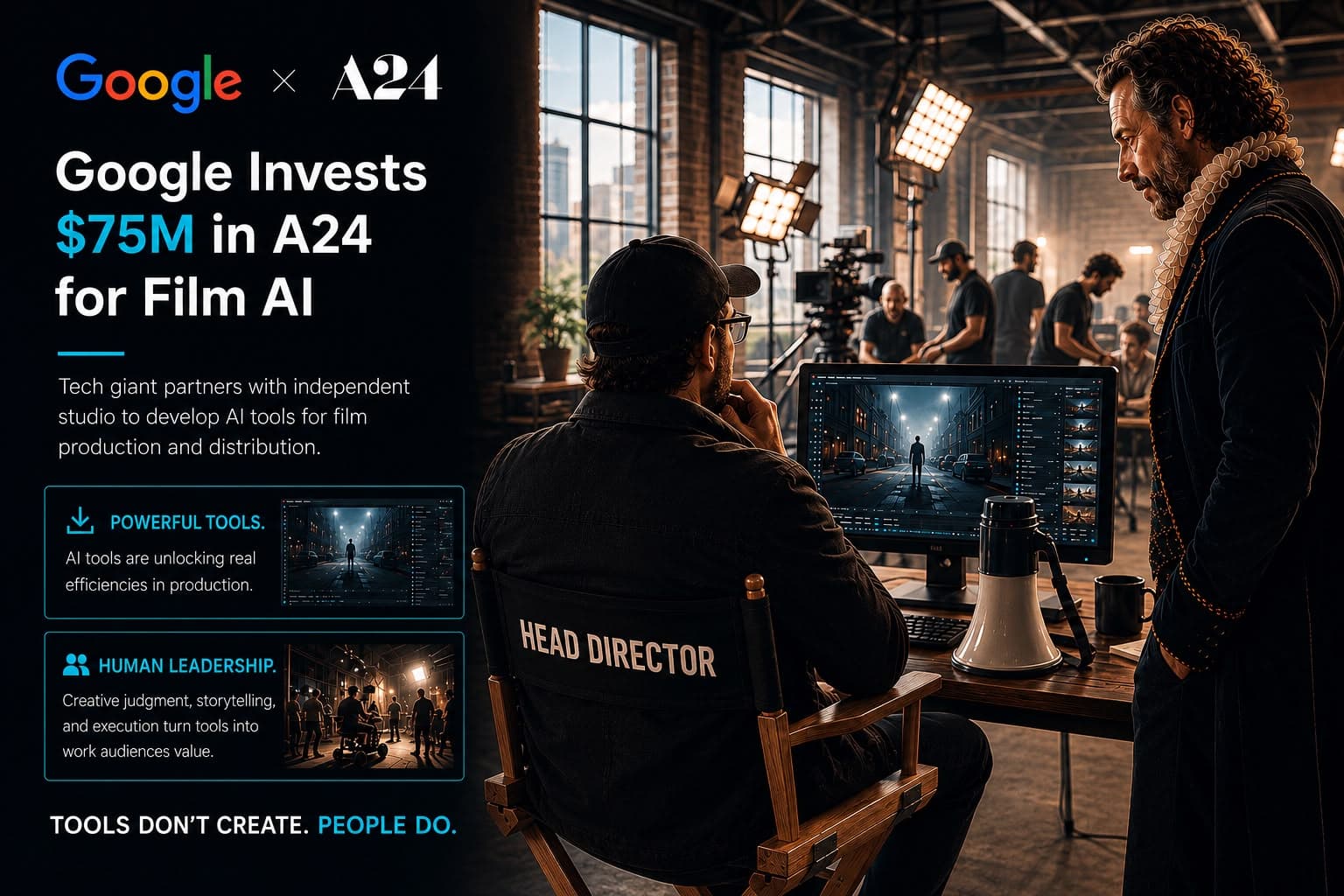
Google's $75 million commitment to A24 points to a practical reality: AI tools matter, but commercial creative production still depends on human judgment, taste, and execution.

Summary
What this article covers
Google's commitment to A24's AI program reinforces that the market is not betting on tools alone. It is betting on creative institutions and operators that can turn powerful, fragmented technology into commercially viable work.
Key Takeaways
Direct answers
- AI's role in creative production is becoming more secure, but its value depends on how it is deployed.
- Commercial AI production requires judgment, taste, workflow design, creative direction, and execution beyond software access.
- Google's A24 investment signals a bet on human-led creative institutions using AI as part of the production process.
Google just committed $75 million to A24's AI program.
The investment says something important about where the market believes value will accrue as AI becomes increasingly integrated into creative production.
AI's place in that process is now secure. What remains unsettled is how the industry and audiences understand and frame its role.
The tools are powerful. The efficiencies are real. The economic incentives are too significant to ignore.
But the fact that anyone can access these tools has also created a distorted perception of what they are capable of.
Today, anyone can download Higgsfield, spend a few dollars generating a video clip, and have an AI experience. But generating a clip is not the same thing as producing work that clears commercial standards.
People often see the easiest thing the technology can do and mistake it for the entirety of the medium.
We encounter this constantly. As an AI-enabled production studio, we walk into meetings where AI is often evaluated through the lens of novelty rather than the realities of professional production.
As powerful as these tools are, they remain fragmented, unpredictable, and highly dependent on operator skill. Producing commercially viable work requires far more than access to software. It requires judgment, taste, workflow design, creative direction, and execution.
Google's investment in A24 reflects that reality.
If the human layer were becoming less important, Google could have spent another $75 million building technology. Instead, it invested in a company whose primary assets are creative talent, storytelling capability, and cultural relevance.
This is not a bet against AI.
It is a bet on how AI will actually be deployed.
Google is attaching its technology to a human-led creative institution and, in doing so, helping establish AI as a tool within the creative process rather than a replacement for it.
As the novelty fades and audiences become more accustomed to AI-assisted workflows, the conversation will shift away from whether AI belongs in creative production and toward who can use it effectively.
The tools matter.
But tools don't create.
People do.
FAQ
Common questions
What does Google's A24 investment say about AI production?
It suggests the market sees value in pairing AI technology with human-led creative institutions that can apply the tools with taste, direction, and commercial discipline.
Can AI tools replace the human layer in creative work?
The article argues no. AI tools are powerful, but producing professional work still requires creative judgment, workflow design, and execution.
Why is access to AI software not enough?
Generating a clip is different from producing work that clears commercial standards. Professional results require operators who know how to direct, refine, review, and deliver the work.