
AI Filmmaking
It Looks Like a Guy Ritchie Film. Nobody Was Ever on Set.
Higgsfield's feature-length experiment shows how far generative video has come, and why the quality still depends on people who know how to work around its limits.
Summary
What this article covers
The Cully Hill Boys is a useful demonstration of both the progress and the limits of generative video: a 110-minute feature made without a camera or a set, but shaped by a script, taste, technical expertise, and 473,214 generations of human-directed iteration.
Key Takeaways
Direct answers
- The Cully Hill Boys raises the continuity and likeness problems of generative video to feature-film scale and publishes the result for anyone to inspect.
- A polished AI feature is the ceiling of generative production today, not the standard that every accessible tool can deliver on its own.
- Seedance 2.5 can help with continuity, but people still need to understand the models, navigate their instability, and make the creative decisions.
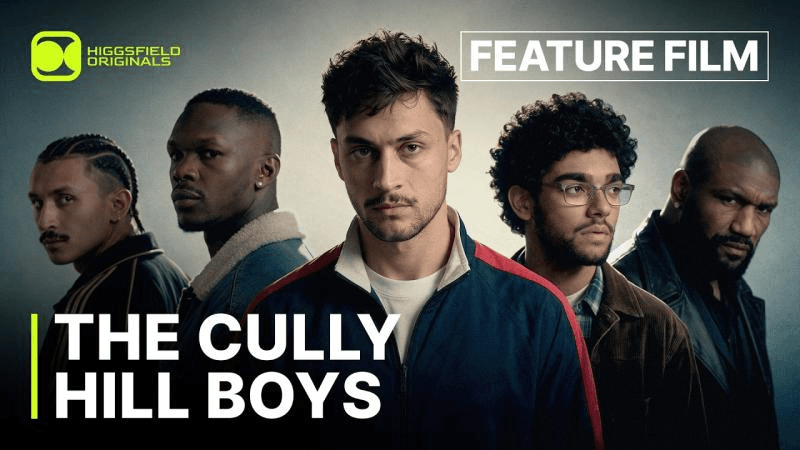
Last week Higgsfield released a feature film, The Cully Hill Boys. 110 minutes. An action-comedy about three East London rappers who lift the wrong guy's money and spend the rest of the movie paying for it. It cuts like Lock, Stock. Four weeks to make, roughly $2 million, no camera, no set. The leads are real people, Israel Adesanya, Rampage Jackson, the streamer N3on, licensed likenesses, none of whom filmed a frame. Every shot was generated.
First, the technology. The central instability in generative video is continuity. Faces drift. Rooms shift. Light wanders. The longer a shot runs, the more the seams show. It has a social problem too. As we wrote last week, audiences don't watch this material, they inspect it, grading the technology on how well it conceals itself. So consider what Higgsfield released. A feature, where continuity has 110 minutes to fail. A cast of famous faces, where every viewer already knows exactly what Adesanya looks like. Free, where the audit is open to anyone. On the two hardest problems in the medium, they raised the stakes as high as they would go, and published.
Seedance 2.5 was the central video model used to create the film, which makes the project as much a trial for the platform as for the filmmakers. It is a test of whether the technology can carry those two challenges at feature scale, and by any honest viewing, the work impresses.
But AI did not make this movie. Underneath the technology is a real script, an award-winner off the Black List, because two hours of story collapses without one. The prompts name-check Guy Ritchie and Edgar Wright because whoever wrote them had watched Snatch and knew why it cuts the way it cuts. Producing 110 finished minutes took 473,214 generations, roughly seventy for every second that survived.
Keep that level of iteration in mind when you look at what is showing up in our social feeds. The AI work seems to improve every week: polished trailers, complex shots, now whole features. The impression forming is that this is simply what the technology does now.
It isn't.
Work like The Cully Hill Boys is the ceiling of generative production today, not the standard. The tools that made it are inexpensive and widely available. Almost anyone can access them. Almost no one is creating that quality of work.
We are incorporating Seedance 2.5 into our work every day, inside a stack of other models and proprietary workflows we've built around them, and it is already helping us make better work for clients. Among other advances, it does help with the issue of continuity. But it does not solve for it. Instability remains native to generative video production. The work still depends on people with the technical sophistication to navigate that instability, know what the systems can reliably deliver, and build around where they cannot. Beyond that expertise, there is still no machine substitute for human taste and judgment. Tools do not create. People do.
The Cully Hill Boys is such a useful demonstration because it shows both how far the technology has come and what it looks like when people who understand it know how to navigate its limits and integrate it into the creative process.
One more thing, and I'll admit my bias.
The Cully Hill Boys is about three broke rappers trying to make a name for themselves. We made a show about a rapper trying to make it in Mumbai. Two seasons, five million views, distribution deal. Took us years and a camera.
They did theirs in four weeks.
We're not mad about it. We're taking notes.
FAQ
Common questions
What is The Cully Hill Boys?
It is a 110-minute action-comedy released by Higgsfield about three East London rappers who steal the wrong man's money. The film was generated without a camera or a physical set, using licensed likenesses for its real-world cast.
How was the film made?
Seedance 2.5 was the central video model, working from a real script and a highly iterative production process. The team produced 473,214 generations, with roughly seventy generations for every second that survived into the finished film.
Does generative video solve continuity?
Not yet. Newer models can improve continuity, but faces, rooms, light, and other details can still drift. Professional results depend on people who understand those failure modes and build a workflow around them.